
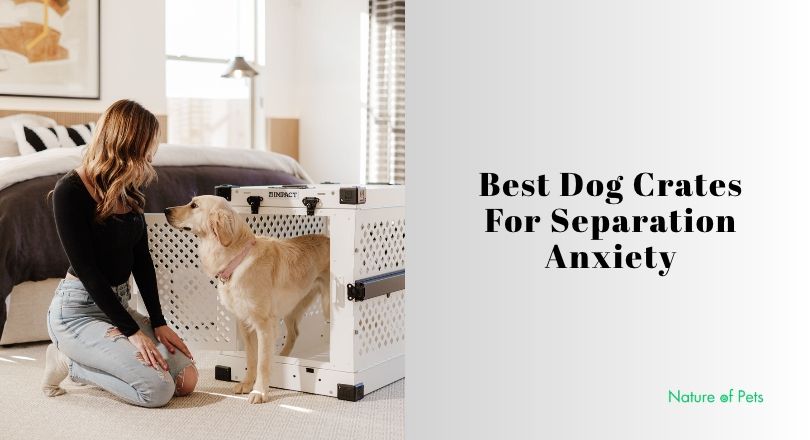
Need a safe spot for your dog when you’re gone? Finding the best Dog Crates For Separation Anxiety means picking between open wire frames and closed, den-like boxes. Some dogs calm down behind bars, while others need solid walls to stop pacing and chewing.
We compared five crates by their materials, doors, and build. You’ll see what each one does well and where it falls short, so you can match the right box to your dog’s habits.
Our Top Picks
| # | Product | ||
|---|---|---|---|
| 1 |  | Rexwelten Heavy Duty Crate Best Enclosed Design | Check Price |
| 2 |  | HOOBRO Wooden Dog Crate Best Furniture Style | Check Price |
| 3 | 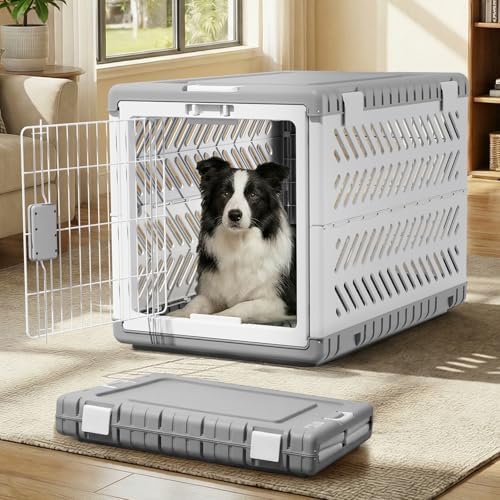 | Gardner Pet Collapsible Crate Easiest to Move | Check Price |
| 4 |  | XVISHX Foldable Dog Crate Most Chew Resistant | Check Price |
| 5 |  | DWANTON Dog Crate Furniture Best Compact Indoor | Check Price |
1. REXWELTEN 42″ Heavy Duty Dog Crate Furniture
Best for: Dogs that panic in open wire crates.
The enclosed design uses sturdy panels instead of metal bars, which blocks outside movement that often triggers anxious dogs. Small holes with a 0.5 inch diameter let air flow without giving your pet much to chew on. That means a nervous dog gets a den-like space instead of a wide-open cage.
It’s built from high-quality steel and reinforced particleboard to resist damage and rusting. The removable metal floor wipes clean fast and won’t trap paws like wire grates do.
A wire grate leaves gaps where waste collects and paws catch. This flat panel gives stable support across the entire surface.
The crate comes with a one-year warranty covering quality problems from the purchase date. Rexwelten will provide a replacement or refund if something fails.
However, this isn’t the crate for a small dog that prefers seeing the whole room, since the solid walls block their view entirely.
Pros
- Solid panels create a secure den space
- Removable metal floor wipes clean easily
- Double doors use upgraded escape-proof locks
Cons
- Solid walls block all outside visibility
2. HOOBRO Wooden Dog Crate
Best for: Keeping your living room looking normal.
This crate works as a side table or nightstand, so it doesn’t look like a cage sitting in your home. The overall size is 38.6″L x 25.6″W x 26.9″H, leaving an inner house of 32.9″L x 23.8″W x 23.2″H. It holds up to 90 lb, fitting medium and large dogs comfortably inside.
You can place a potted plant or pet supplies on the flat top surface. That turns dead space into part of your bedroom or living room decor.
A pull-out tray catches messes, and the intensive bottom net protects your dog’s feet from getting stuck. It’s made of particleboard and steel for chew-resistance, with front and side openings for easy access.
The dual doors let you push this against any wall without blocking entry. A single-door kennel forces you to leave clearance that eats up floor space.
Assembly uses numbered parts and simplified steps to speed up the build.
Pros
- Functions as a modern rustic end table
- Pull-out tray keeps daily cleanup simple
- Front and side doors offer flexible placement
Cons
- It holds up to 90 lb
3. Gardner Pet Collapsible Crate
Best for: Moving an anxious dog between rooms easily.
The one-piece folding design sets up in seconds without any tools, which helps when you need to move fast. Two smooth-rolling wheels and sturdy handles let you roll it across the house smoothly. That means you don’t have to leave your nervous dog alone in one fixed spot all day.
It uses squeeze-latch locks that are easy for you but hard for clever dogs to open. The build mixes high-quality PE and strong metal wire, and curved corners prevent chin or claw pinching. DELETE.
When installing, ensure front and rear panels snap into correct positions. Give them a firm pull to verify they’re securely locked in place. Be careful the cage doesn’t slip during assembly, as falling panels can pinch fingers or arms.
Pros
- Folds flat instantly with zero tools needed
- Wheels and handles make moving it effortless
- Squeeze-latch locks keep smart dogs safely inside
Cons
- Plastic parts may not survive aggressive chewers
- Panels must be snapped firmly during setup
4. XVISHX Foldable Dog Crate
Best for: Traveling with a dog that scratches fabric.
The frame uses thickened steel pipe, and the fabric is 620D Oxford cloth with stronger leather wrapped around all four corners. That mix stops most scratching and chewing before it tears the material apart. Your dog gets a soft space that still stands up to nervous pawing.
Breathable mesh covers the top and sides to keep airflow moving, and the multi-door design lets your pet enter from different spots. It measures 36x25x25 inches, folding down compactly for car trips. Don’t buy this for a dog that destroys everything in sight, because persistent teeth will eventually shred the Oxford cloth.
A single owner can fold and carry it without help. Assembly takes only a few seconds and requires no tools at all. Traditional iron crates are bulky by comparison and much harder to store. This one fits both indoor and outdoor use easily.
If the crate arrives damaged or with missing parts, contact the seller on Amazon right away. They commit to resolving defects quickly.
Pros
- Leather-wrapped corners resist scratching and chewing
- Thickened steel pipe keeps the soft frame rigid
- Mesh windows provide constant breathable airflow
- Sets up in seconds without any tools
Cons
- Fabric will eventually yield to extreme chewers
5. DWANTON 27″ Dog Crate Furniture
Best for: Small dogs needing a cozy indoor spot.
This 27-inch crate doubles as a side table, giving you a flat top for lamps or picture frames. It comes with a matching waterproof cushion, so your dog has a soft place to sleep right away. A wooden plate sits at the bottom to stop feet from jamming into gaps.
The build uses particleboard and wire construction to resist chewing, and double doors make entry simple. Adjustable feet keep the crate stable even if your floors aren’t perfectly flat. Measure your dog’s height and length carefully before choosing this compact frame.
If choosing the right fit feels uncertain, leave your pet’s breed and measurements in the Q&A area for a specific recommendation. The wide top provides enough place to put decorations such as small or medium plants, magazines, and night lamps. Double doors allow flexible placement against walls or furniture since access isn’t limited to one side.
Pros
- Includes a matching waterproof cushion inside
- Wooden bottom plate prevents painful foot jams
- Adjustable feet keep it level on uneven floors
Cons:
Two other crates might fit specific needs. The YATINEY Foldable Dog Crate offers a DIY frame and hooks for small to medium dogs, working as a wooden end table. The LE SURE XL Dog Crate is a soft, collapsible 42-inch option if you need a larger fabric kennel.
How to Choose a Crate for Separation Anxiety
Enclosed vs Open Design
Anxious dogs often panic when they see too much movement. An enclosed crate with solid panels mimics a den, blocking visual triggers. Open wire crates work better for dogs that feel trapped by walls. Pick the style that matches how your dog reacts when left alone.
Material Strength
Nervous dogs scratch, bite, and push against their crates. Look for high-quality steel or thick steel pipes if your dog is a heavy chewer. Particleboard adds a furniture look but can splinter under sharp teeth. Match the material to your dog’s worst habit.
Size and Inner Space
A crate that’s too big lets a dog pace, while a tight one causes stress. Measure your dog’s height and length while standing and lying down. Check the inner dimensions, not just the outer size. Ensure they can turn around without hitting the walls.
Locks and Doors
Smart dogs figure out basic latches fast. Escape-proof locks or squeeze-latches keep clever paws from opening the door. Double doors give you flexibility in where you place the crate. Make sure the locking mechanism is easy for you but hard for them.
Cleaning and Maintenance
Anxious dogs sometimes have accidents in their crates. A removable floor or pull-out tray saves you from scrubbing tight corners. Waterproof cushions help, but the base material matters most. Avoid wire floors that can trap nails or hurt paws during a panic.
Portability
If you move your dog around the house, heavy steel becomes a burden. Foldable designs with wheels let you change rooms quickly. Soft crates are lighter but offer less security against escaping. Decide if the crate stays put or travels with you.
Narrow your choice by watching your dog’s behavior first. If they chew, prioritize steel and leather-wrapped corners. If they pace, choose an enclosed shape. Always measure their body before buying, and check the warranty to ensure you’re covered if they break something.
Common Crate-Buying Mistakes to Avoid
Choosing the Wrong Size
Buyers often grab a large crate thinking more room equals comfort. For an anxious dog, too much space encourages pacing and panic. A crate should let them stand, turn, and lie down snugly. Always measure your dog’s exact height and length first.
Manufacturers provide specific inner dimensions that differ from exterior measurements. A particular wooden model measures 38.6 inches long outside but only 32.9 inches inside. Relying solely on the external size risks buying a space that’s too tight for movement.
Check weight ratings alongside physical measurements to ensure structural safety. Some furniture-style crates support up to 90 pounds while others handle 200 pounds. Exceeding these limits compromises stability and creates unsafe conditions for heavier dogs experiencing stress.
Ignoring Chewing Habits
Picking a wooden or fabric crate for a heavy chewer leads to quick destruction. Buyers focus on how the crate looks in their living room. Instead, check the material strength against your dog’s history. Steel frames or reinforced corners are necessary for dogs that bite when stressed.
Fabric crates can resist damage if constructed with thickened steel pipes and leather-wrapped corners. Standard soft carriers lack this reinforcement and fail quickly under anxiety-induced chewing. Verify the frame composition before assuming fabric automatically means vulnerability.
Wooden crates using particleboard and steel offer chew resistance without sacrificing home aesthetics. This combination provides pet-safe durability for dogs that test boundaries. Pure wood constructions can’t withstand determined biting during separation episodes.
Overlooking Lock Security
Standard slide-bolt latches are easy for desperate paws to push open. Owners assume any lock works until their dog escapes. Look for upgraded locks or squeeze-latches designed to confuse clever dogs. A secure door is the only thing between your pet and a damaged home.
Self-locking zipper systems prevent escapes in soft-sided models where traditional latches can’t function. These mechanisms secure containment differently than metal bolts. An integrated leash adds another layer of security for dogs that test fabric barriers.
Skipping Floor Protection
This causes pain and makes the anxiety worse. Choose a solid metal panel or a wooden bottom plate. A flat surface keeps paws safe during stressful moments.
Removable metal floor panels provide stable support while allowing hygiene maintenance. Unlike fixed wire grids, these solid surfaces prevent paw injuries during anxious pacing. The removable design maintains cleanliness without sacrificing safety.
Forgetting Airflow Needs
Solid, enclosed crates calm dogs down, but buyers sometimes forget about breathing room. Without proper ventilation, the space gets hot and stuffy. Ensure the crate has ventilation holes or breathable mesh panels. Good airflow keeps your dog comfortable while they wait for you.
Enclosed designs use strategically placed half-inch holes rather than open bars to balance security with air circulation. This creates a den-like environment. Four-side zippered mesh walls offer maximum breathability for soft crates used during travel.
Assuming Assembly Is Simple
Some crates require many steps, frustrating owners who need them set up fast. Buyers skip reading the assembly instructions before purchasing. Check if the crate offers no-tool assembly or numbered parts. A complicated build delays helping your anxious dog settle in.
Single-unit folding designs eliminate complex assembly entirely by unfolding and locking in seconds. Numbered parts with comprehensible instructions simplify traditional builds when folding options are unavailable. Verify the setup method matches your urgency before ordering.
FAQ
Do enclosed crates really help separation anxiety?
Yes, for many dogs. Solid walls block out movement and noise that trigger panic. They mimic a natural den, making the dog feel hidden and safe. However, some dogs prefer seeing their surroundings, so watch your pet’s reaction first.
Can my dog chew through a soft foldable crate?
It depends on the materials. Crates using thickened steel pipes and 620D Oxford cloth resist light scratching. But a dog in full panic mode with strong jaws can eventually tear fabric. If your dog destroys everything, stick to heavy-duty steel.
How do I know what size crate to buy?
Measure your dog from nose to tail base, and from floor to the top of their head. Add a few inches to both numbers. The inner dimensions of the crate should match those measurements so they can stand and turn without extra pacing room.
Are furniture-style crates safe for anxious dogs?
They work well for mild anxiety because they blend into the home and feel less like a cage. But particleboard and wood can splinter if a dog chews aggressively. Only use them if your dog doesn’t try to eat their way out.
What kind of lock prevents escapes?
Look for squeeze-latch locks or upgraded escape-proof mechanisms. Standard slide bolts are too easy for smart dogs to nudge open. The lock should require human finger dexterity to operate, keeping paws from figuring it out.
Should I leave water inside the crate?
For short absences, a spill-proof bowl attached to the door works fine. If your dog panics and knocks things over, loose bowls create a wet mess. Secure attachments keep them hydrated without flooding the crate floor.
Conclusion
Pick the crate that matches your dog’s worst habit. If they chew, get steel. If they pace, get an enclosed box. Measure their body, check the lock type, and read the warranty so you know exactly what you’re bringing home.